10 Main Buddhist Sites to Visit in Colombo
Colombo is often seen as Sri Lanka’s commercial and administrative center, but it also holds an important place in the island’s Buddhist landscape.
Unlike the ancient capitals of Anuradhapura or Polonnaruwa, Colombo’s Buddhist sites reflect urban Buddhism – temples that evolved alongside colonial rule, trade, and modern city life. Many of these temples remain active religious centers while also serving as places of education, social work, and national memory.
Below are the main Buddhist sites to visit in Colombo and its immediate surroundings.
1. Gangaramaya Temple, Colombo
One of the most important Buddhist institutions in Colombo, Gangaramaya is both a temple and a cultural complex.
Founded in the late 19th century, it played a major role in the Buddhist revival during the British colonial period. The site combines traditional Sri Lankan architecture with elements influenced by Thailand, China, and India. It also houses a museum-like collection of religious artifacts, manuscripts, statues, and donated objects from around the world.
Gangaramaya functions as a place of worship, learning, and social service rather than a quiet monastic retreat.
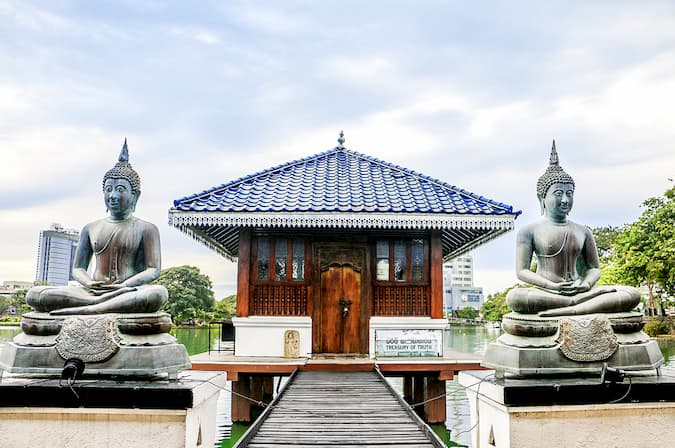
2. Seema Malaka Temple, Colombo
Seema Malaka is an extension of Gangaramaya, located directly on Beira Lake.
Designed by architect Geoffrey Bawa, the temple is known for its minimalist layout and open structure. Traditionally used for ordination-related rituals, today it is also a calm space for reflection within the city. The setting emphasizes simplicity, water symbolism, and spatial balance rather than elaborate decoration.
3. Kelaniya Raja Maha Vihara, Colombo
Located just outside Colombo, Kelaniya Raja Maha Vihara is one of the most sacred Buddhist sites in Sri Lanka.
According to tradition, it is associated with a visit by the Buddha during his third journey to the island. The temple is especially known for its 20th-century murals painted by Solias Mendis, depicting scenes from the Buddha’s life and Sri Lankan Buddhist history. Kelaniya continues to play a central role in national religious ceremonies, including the annual Duruthu Perahera.
4. Bellanwila Rajamaha Viharaya, Dehiwala
Bellanwila Rajamaha Viharaya is centered around a sacred Bo Tree believed to be a sapling from the Jaya Sri Maha Bodhi in Anuradhapura.
The temple became prominent in the 20th century and is closely connected with lay Buddhist practice in Colombo’s southern suburbs. It is particularly active during Vesak and Esala Perahera, drawing large local crowds rather than tourists.
5. Sri Sambodhi Chaitya, Colombo
Sri Sambodhi Chaitya is a modern stupa built on pillars near Colombo Port.
Its elevated position makes it visible from a distance, symbolizing protection and blessing for the city and harbor. Visitors can climb inside the structure to reach the upper level, offering views over the port and surrounding areas. The site reflects contemporary Buddhist architecture rather than ancient temple design.
6. Vajiraramaya Temple, Bambalapitiya
Vajiraramaya is an important monastic center associated with scholarly Theravāda Buddhism in Colombo.
It has been home to influential monks involved in Buddhist education, translation, and public discourse. While architecturally modest, the temple is significant for its intellectual and teaching tradition rather than ritual spectacle.
7. Mahamevnawa Bodhignana Monastery, Kaduwela
This monastery is part of the Mahamevnawa movement, known for its focus on early Buddhist teachings preserved in the Pali Canon.
The Bodhignana Monastery in Kaduwela emphasizes disciplined monastic life, meditation, and Dhamma study in a quiet, forest-like setting. Unlike urban temples, it is oriented toward practice and teaching rather than ritual or tourism.
8. Mahamevnawa Amawatura Monastery, Colombo
Mahamevnawa Amawatura Monastery serves as an accessible teaching and meditation center for lay practitioners. It regularly hosts Dhamma talks, meditation programs, and retreats based on early Buddhist discourses. The monastery reflects a modern movement aimed at making foundational Buddhist teachings available to contemporary audiences.
9. Angurukaramulla Temple, Negombo
Located near Negombo town, Angurukaramulla Temple is best known for its large seated Buddha statue and dramatic entrance structure.
The temple has historical roots but is especially notable today for its murals and strong presence within a predominantly Catholic region. It illustrates the coexistence of Buddhist and Christian communities in Sri Lanka’s western coastal belt.
10. Asokaramaya Temple, Bambalapitiya
Asokaramaya is a well-known urban temple associated with preaching, meditation, and public Dhamma discussions.
It gained prominence in the 20th century and is often visited by lay practitioners seeking structured teachings rather than ceremonial worship. Architecturally modest, its importance lies in education and community engagement.
Colombo’s Buddhist sites are best understood not as isolated monuments, but as living institutions shaped by colonial history, urban growth, and modern religious life.
They offer insight into how Buddhism adapted to the capital city – remaining active, public, and socially engaged.
For travellers, Colombo provides a different perspective on Sri Lankan Buddhism: less ancient ruins, more continuity between past and present.

© 2025 Svety Oklad | Meditation Coach, Digital Creator & Wellness Tech Explorer.
Based in Sri Lanka, working worldwide in content creation, SEO, and WordPress optimization.
Please, send your inquiry via contact form.
Discover my portfolio of mindfulness projects, brand collaborations, and digital media strategies. Follow my journey on Instagram and YouTube for meditation, travel, and creative content.