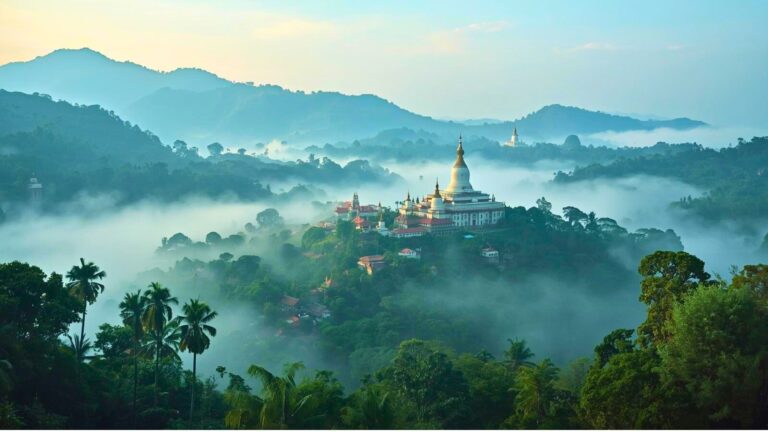
Anuradhapura: The Sacred City Where Buddhism Became a Civilization
Anuradhapura is not simply a historical site, nor a collection of impressive ruins scattered across a dry plain. It is the place where Buddhism ceased to be only a teaching or monastic discipline and became the organizing principle of an entire civilization. For over a thousand years, Anuradhapura functioned as a living Buddhist capital — political, spiritual, architectural, and ecological — shaping how Buddhism would be practiced, understood, and embodied in Sri Lanka and beyond.
Unlike many ancient religious centers that exist today only as archaeological memory, Anuradhapura remains active. Monks still chant in its monasteries. Pilgrims still circumambulate its stupas at dawn. Devotees still offer water, flowers, and oil lamps at shrines whose foundations were laid over two millennia ago. This continuity — unbroken despite invasions, collapse, abandonment, and rediscovery — is what makes Anuradhapura unique.
To understand Anuradhapura is to understand how Buddhism can structure not just inner life, but society itself.
The Birth of a Buddhist Capital
Anuradhapura rose to prominence in the 4th century BCE, becoming the first enduring capital of Sri Lanka. Its transformation into a Buddhist city occurred in the 3rd century BCE during the reign of King Devanampiya Tissa, following the arrival of Arahant Mahinda, the son of Emperor Ashoka of India.
This was not a superficial conversion. Buddhism was adopted as a state-supported ethical and philosophical system, integrated into governance, education, urban planning, and environmental management. Monasteries were endowed with land. Kings ruled as protectors of the Sangha. Public works — roads, reservoirs, hospitals — were understood as meritorious acts aligned with Buddhist values.
From this point onward, Anuradhapura evolved not merely as a capital, but as a sacred city whose legitimacy was inseparable from the Dharma.
The Sri Maha Bodhi: A Living Axis of the City
At the spiritual heart of Anuradhapura stands the Sri Maha Bodhi, the oldest historically authenticated tree in the world still tended by humans. Grown from a cutting of the original Bodhi tree in Bodh Gaya under which the Buddha attained enlightenment, it was brought to Sri Lanka in the 3rd century BCE by Sanghamitta Theri.
This tree is not symbolic. It is alive. It is guarded, watered, and ritually honoured every single day.
Unlike stupas, which enshrine relics of the Buddha’s physical body, the Sri Maha Bodhi represents something subtler: the presence of awakening itself. Pilgrims approach it quietly. Offerings are restrained. The atmosphere is contemplative rather than grand. Many Sri Lankans consider this tree the true heart of the island’s Buddhism — not because of size or spectacle, but because it embodies continuity, patience, and living memory.
The layout of Anuradhapura radiates outward from this sacred center, reflecting a cosmology where enlightenment is not abstract but geographically rooted.
The Stupa Culture: Architecture as Devotion
Anuradhapura is defined visually by its stupas — massive, white, dome-shaped structures rising above the plain like frozen moons. These are not temples in the congregational sense. They are reliquaries, built to house relics of the Buddha or great arahants, and to act as objects of meditation.
Among the most significant are:
The Ruwanwelisaya, built by King Dutugemunu in the 2nd century BCE, is considered the most sacred stupa in Sri Lanka. Its perfect proportions are said to embody harmony between earth and sky. Even today, it draws thousands of pilgrims daily, especially during full moon days.
The Jetavanaramaya was once the tallest brick structure in the world. Its sheer scale speaks not of imperial ego, but of collective devotion: generations of laypeople contributed labor and resources as acts of merit.
The Thuparamaya, believed to enshrine the Buddha’s collarbone relic, is the earliest stupa built in Sri Lanka and marks the formal establishment of Buddhism on the island.
Circumambulating these stupas clockwise is not ritual for its own sake. It is meditation in motion — aligning body, direction, and intention.
Monastic Universities and Philosophical Diversity
Anuradhapura was not monolithic in its Buddhism. It housed multiple monastic complexes, each representing different interpretations, disciplines, and pedagogical approaches.
The Mahavihara was the stronghold of orthodox Theravāda Buddhism, emphasizing strict adherence to the Pali Canon and monastic discipline.
The Abhayagiri, by contrast, was more cosmopolitan and open to Mahāyāna and Vajrayāna influences from India and beyond. It attracted scholars, translators, and travelers from across Asia.
These were not marginal differences. They shaped centuries of doctrinal debate, textual transmission, and practice. Anuradhapura functioned as a pan-Asian Buddhist intellectual hub long before the modern university existed.
The ruins of these monasteries — image houses, meditation paths, refectories, bathing ponds — still outline a complete monastic ecosystem designed to support contemplation, study, and ethical life.
Water, Ecology, and Buddhist Kingship
One of Anuradhapura’s most remarkable features is its hydraulic system. Vast reservoirs — tanks, canals, and spillways — were engineered with extraordinary precision, transforming a dry zone into fertile land.
This was not purely economic infrastructure. In Buddhist political philosophy, a righteous king ensures the material well-being of the people as an extension of compassion. Providing water was an act of Dharma.
The city’s layout reflects this ethic: monasteries integrated with irrigation, agriculture aligned with ritual calendars, and forests preserved as spaces for meditation. Anuradhapura demonstrates a rare historical example of large-scale urban planning guided by ethical and spiritual principles rather than extraction alone.
Decline, Abandonment, and Return
By the 10th century CE, Anuradhapura declined due to South Indian invasions, political instability, and shifts in trade routes. The capital moved south to Polonnaruwa. The sacred city was gradually reclaimed by jungle. Yet it was never forgotten.
Pilgrims continued to visit the Sri Maha Bodhi. Monks maintained shrines in partial isolation. In the 19th century, Anuradhapura was rediscovered, restored, and re-established as a major pilgrimage center.
Today, it exists in a rare dual state: archaeological park and living religious city. This coexistence is not always neat, but it preserves something essential — the sense that Buddhism here is not a museum artifact, but a breathing tradition.
Places to visit in Anuradhapura
To visit Anuradhapura properly requires time and restraint. This is not a place to rush. Early mornings and late afternoons reveal its true character, when pilgrims outnumber tourists and the light softens the ruins.
Dress modestly. Walk slowly. Observe how locals interact with the space. Notice the silence between chants, the barefoot paths worn smooth by centuries of devotion.
1. Jaya Sri Maha Bodhi: A sacred fig tree believed to be a sapling from the original Bodhi Tree in India under which the Buddha attained enlightenment. Planted in 288 BCE, it is one of the oldest historically documented trees in the world and a major pilgrimage site.
2. Ruwanwelisaya Stupa: A massive ancient stupa built by King Dutugemunu in the 2nd century BCE. It’s one of the “Atamasthana” (eight sacred sites) and one of the tallest ancient monuments in the world, revered for its spiritual significance.
3. Jetavanaramaya: Once one of the tallest structures in the ancient world, this enormous stupa was built in the 3rd century CE. It remains a dominant landmark and sacred site in the monastic complex.
4. Thuparamaya: The first stupa built in Sri Lanka after the introduction of Buddhism, constructed by King Devanampiya Tissa in the 3rd century BCE. It houses the Buddha’s relic and is considered profoundly sacred.
5. Abhayagiri Vihāra & Dagaba: One of the largest ancient Buddhist monastic complexes where both Theravāda and Mahāyāna traditions flourished. The Abhayagiri Dagaba remains a powerful spiritual monument among ruins of monastic buildings.
6. Mirisaveti Stupa: Part of the eight sacred sites, this stupa was built by King Dutugemunu close to Ruwanwelisaya. Its name means “the chili powder stupa,” linked with rituals of protection.
7. Lankarama: A circular stupa included in the Atamasthana group, distinguished by its encircling stone pillars and platforms, reflecting early Sinhalese architecture.
8. Isurumuniya Temple: Historic Buddhist temple near Tissa Wewa, famous for its rock carvings, including the “Isurumuniya Lovers” sculpture and tranquil surrounding ponds.
9. Vessagiriya Monastery: Ancient rock monastery with paths and shelters carved into boulders where monks once lived meditating. A quieter part of the Anuradhapura monastic ruins.
10. Anuradhapura Maha Viharaya: The original great monastery that became the foundational center of Theravāda Buddhism in Sri Lanka, established by King Devanampiya Tissa.
Anuradhapura rewards those who approach it not as spectators, but as participants — even briefly — in a long continuum of practice.
Why Anuradhapura Still Matters
Anuradhapura answers a question modern Buddhism often avoids: what does it look like when an entire society tries — however imperfectly — to organize itself around ethical awareness, restraint, and liberation?
It shows that Buddhism can scale beyond the cushion and the monastery, shaping cities, laws, art, and ecology. It also shows the fragility of such experiments, and the humility required to sustain them.
In Anuradhapura, Buddhism is not reduced to mindfulness techniques or decorative symbolism. It is architecture, water, silence, debate, labor, and time.
And that is precisely why this ancient city still speaks — quietly, insistently — to the present.

© 2025 Svety Oklad | Meditation Coach, Digital Creator & Wellness Tech Explorer.
Based in Sri Lanka, working worldwide in content creation, SEO, and WordPress optimization.
Please, send your inquiry via contact form.
Discover my portfolio of mindfulness projects, brand collaborations, and digital media strategies. Follow my journey on Instagram and YouTube for meditation, travel, and creative content.