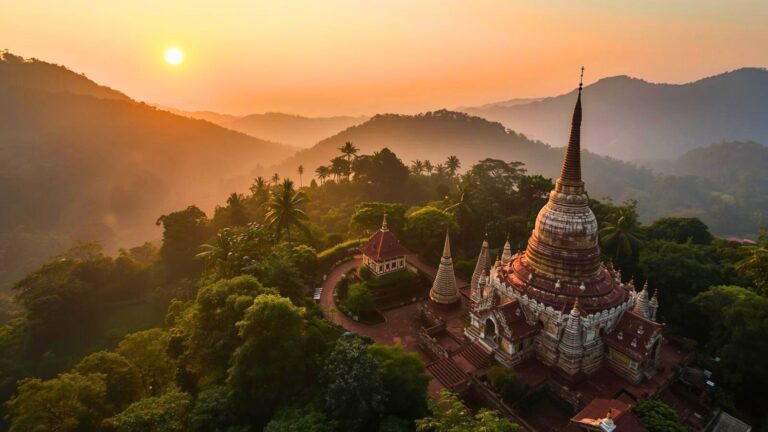
Southern Sri Lanka is often framed through beaches, surf towns, and colonial ports. Beneath this coastal narrative lies a quieter and older geography. It is a landscape shaped by Buddhist temples, cave monasteries, forest hermitages, and pilgrimage sites that continue to influence daily life, ethical values, and contemplative practice across the region.
Unlike the monumental ancient cities of the north central plains, southern Sri Lanka offers something more intimate. Here, Buddhism is not preserved mainly as archaeological heritage. It is lived as a continuous tradition. Temples function as places of worship, learning, meditation, community gathering, and moral orientation. Forest monasteries and aranya senasanayas maintain the ascetic strand of Theravada practice, often deliberately distant from roads and crowds.
This article explores the most significant Buddhist temples, monasteries, and sacred sites in southern Sri Lanka, with an emphasis on historical depth, spiritual function, and present day relevance rather than tourism alone.
Buddhism in the Southern Landscape
Theravada Buddhism has been present in southern Sri Lanka for more than two thousand years. Ancient chronicles and inscriptions indicate that monastic settlements flourished here alongside trade routes connecting the island to South India and the wider Indian Ocean world.
The southern region has long supported two complementary modes of practice. One is village and urban temples that serve lay communities through rituals, sermons, education, and festivals. The other is remote monasteries and cave hermitages dedicated to meditation, renunciation, and intensive discipline. This balance between community based Buddhism and forest practice continues today.
Mulgirigala Raja Maha Viharaya, Hambantota
Mulgirigala Raja Maha Viharaya is one of the most significant ancient monastic complexes in southern Sri Lanka. Often compared to Sigiriya on a smaller scale, it is a massive rock formation rising from the surrounding plains and housing more than twenty caves once used by monks for meditation and residence.
The site dates back to the second century BCE and was historically patronised by southern kings. The caves contain well preserved Kandyan era murals depicting scenes from the Buddha’s life, Jataka stories, and symbolic cosmology. Stone stairways connect multiple terraces with image houses, stupas, and inscriptions.
Beyond its visual impact, Mulgirigala remains a functioning religious site. Monks still reside here and pilgrims visit regularly, especially on Poya days. The physical ascent itself functions as a contemplative act, where effort mirrors inner discipline.
Sithulpawwa Raja Maha Viharaya, Near Yala National Park
Sithulpawwa is among the oldest and most revered monastic sites in southern Sri Lanka. Founded in the second century BCE, it once supported thousands of monks and served as a major centre of learning and meditation.
Situated on a rocky outcrop overlooking the dry zone forests near Yala, Sithulpawwa combines isolation with accessibility. Ancient stupas, stone pathways, cave dwellings, and monastic ruins remain visible across the site.
Historically linked to Tissamaharama and the southern royal courts, Sithulpawwa remains an active pilgrimage destination while preserving an atmosphere of solitude. The surrounding landscape, especially at dawn and dusk, reinforces its contemplative character.
Tissamaharama Raja Maha Viharaya
Tissamaharama Raja Maha Viharaya is one of the most important Buddhist temples in southern Sri Lanka both historically and ritually. Its massive white stupa dominates the town and reflects the ancient connection between southern kingship and the Buddhist Sangha.
According to tradition, the stupa enshrines sacred relics and was constructed with royal patronage in the early centuries BCE. The temple complex has been continuously maintained and remains a focal point of devotion for the region.
Tissamaharama stands as evidence that southern Buddhism was never peripheral. It played a central role in sustaining monastic education, pilgrimage networks, and ritual life.
Yatagala Raja Maha Viharaya, Galle
Yatagala Raja Maha Viharaya is a rock temple with a history extending over two millennia. Located near Unawatuna yet sheltered from coastal activity, it demonstrates how sacred sites in Sri Lanka often coexist quietly alongside modern development.
The temple includes cave shrines, ancient inscriptions, and a seated Buddha image carved into stone. Natural rock overhangs create spaces conducive to meditation, while surrounding trees soften sound and light.
Yatagala remains a living temple, frequented mainly by local devotees rather than large tour groups. Its significance lies in continuity and atmosphere rather than scale.
Wewurukannala Buduraja Maha Viharaya, Dikwella
Wewurukannala Buduraja Maha Viharaya is known for housing one of the tallest seated Buddha statues in Sri Lanka. While the statue itself is relatively modern, the temple complex incorporates older shrines and didactic spaces illustrating Buddhist cosmology.
Visitors traditionally pass through a corridor depicting suffering, impermanence, and ethical consequence before emerging into the open space dominated by the Buddha image. This architectural progression is intentional and designed to provoke reflection rather than spectacle.
Wewurukannala reflects a pedagogical approach to Buddhism that communicates moral and philosophical themes directly to lay audiences.
Forest Monasteries and Aranya Senasanayas
Southern Sri Lanka is particularly rich in forest monasteries known as aranya senasanayas. These sites emphasise meditation, discipline, and simplicity, often limiting access and maintaining strict codes of conduct.
Weduwa Aranya Senasanaya near Koggala is a notable example. Situated away from urban centres, it offers an environment suitable for sustained practice. Monks here typically follow a Vinaya oriented lifestyle focused on meditation and study rather than ritual services.
Thalathuduwa Aranya Senasanaya near Habaraduwa is another small forest hermitage, less known but deeply respected locally. Such places are rarely promoted publicly and rely on discretion and sincerity from visitors.
These monasteries preserve the forest tradition that has defined Sri Lankan Buddhism for centuries, tracing back to the earliest arahants described in the Pali Canon.
Urban and Community Temples in the South
Cities such as Galle and Matara host numerous urban temples that serve as cultural and ethical anchors for local communities.
Sri Sudharmalaya in Galle town is one such temple, known for regular sermons, educational activities, and social engagement. These temples play a crucial role in transmitting Buddhist values to younger generations and maintaining continuity amid social change.
Unlike forest monasteries, urban temples engage directly with concerns of daily life, including family responsibilities, work related stress, ethical dilemmas, and communal harmony.
Tsunami Honganji Viharaya, Peraliya
Built as a memorial to the victims of the 2004 Indian Ocean tsunami, Tsunami Honganji Viharaya represents a modern Buddhist response to collective trauma.
The temple functions as both a place of remembrance and a symbol of compassion and resilience. Its location along the southern railway line serves as a reminder of impermanence expressed through contemporary history rather than ancient legend.
Japanese Peace Pagoda Rumassala, Galle District
The Japanese Peace Pagoda at Rumassala is essential to any contemporary understanding of southern Sri Lanka’s Buddhist landscape. Built by the Nipponzan Myohoji order after the tsunami, it represents global Buddhist peace movements and silent contemplative presence rather than ritual practice.
Its inclusion acknowledges modern and transnational expressions of Buddhism layered onto ancient sacred terrain.
Weherahena Poorwarama Rajamaha Viharaya, Matara
Weherahena Poorwarama Rajamaha Viharaya is often overlooked in academic writing due to its scale and visual intensity, yet it is one of the most influential teaching temples in the south.
It houses one of the largest seated Buddha statues in Sri Lanka, extensive underground galleries, and detailed murals illustrating samsara, moral causality, and liberation. Designed for lay understanding, the underground chambers function as a three dimensional Dhamma narrative guiding reflection before emergence into light.
Kirinda Raja Maha Viharaya, Tissamahar
Kirinda is both historically ancient and spiritually active. According to tradition, Queen Viharamahadevi landed here after being set adrift at sea, embedding the site deeply in Sri Lankan historical memory.
The clifftop stupa overlooking the Indian Ocean reinforces teachings on impermanence and exposure. The temple remains a major pilgrimage stop, particularly for those traveling between Tissamaharama and Kataragama.
Parey Dewa Raja Maha Viharaya, Between Tangalle and Hambantota
Parey Dewa is a lesser known but extremely important rock temple dating back more than two thousand years. The reclining Buddha image carved into natural rock is among the oldest in southern Sri Lanka.
The site exemplifies early southern monastic life through rock cut architecture, minimal ornamentation, and an emphasis on bodily stillness and contemplation. It is rarely crowded and retains a strong sense of austerity.
Uthpalawanna Sri Vishnu Devalaya Devinuvara, Matara
Although technically a devalaya, this site is integral to understanding southern Sri Lankan Buddhism. Deity worship, particularly of Vishnu as protector of the Buddha Sasana, has historically coexisted with Theravada practice.
Ignoring such sites creates an artificial narrative of pure Buddhism that does not reflect lived religious culture.
Seenigama Muhudu Viharaya, Hikkaduwa
Seenigama Muhudu Viharaya is located on a small island just offshore. It occupies a liminal position between land and sea and has long been associated with ethical vows, protection, and maritime communities.
While often sensationalised, its core significance lies in ethical accountability rather than superstition.
Kanneliya Dediyagala, Galle
This region hosts multiple small forest hermitages and monk dwellings dedicated to deep meditation practice. These sites are intentionally discreet, without signage or tourism infrastructure, and often restrict access.
They represent the continuation of the forest monk lineage that remains central to Theravada authenticity, even when invisible to outsiders.
Mahamevnawa Monasteries in the South
Mahamevnawa monasteries in Galle, Elpitiya, and surrounding areas are among the most influential contemporary Theravada institutions. They emphasise direct study of the Pali Canon, meditation retreats, Vinaya discipline, and public Dhamma talks without ritual excess.
Their presence reflects a modern reform movement focused on early Buddhist teachings.
Experiencing Southern Buddhist Sites Respectfully
Many Buddhist sites in southern Sri Lanka are not tourist attractions. They are active religious environments where daily rituals, meditation, and community life continue uninterrupted.
Visitors are expected to dress modestly, behave quietly, and remain sensitive to ongoing practices. Forest monasteries may restrict access or require permission in order to preserve the integrity of practice.
A Living Tradition
What distinguishes southern Sri Lanka’s Buddhist landscape is continuity. These temples and monasteries are embedded in daily rhythms of life rather than preserved as static heritage.
Morning alms rounds, evening chanting, full moon observances, and silent retreats continue much as they have for centuries. Change occurs, but within a stable ethical framework.
Conclusion
Southern Sri Lanka’s Buddhist temples and monasteries form a subtle yet powerful spiritual geography. From ancient rock sanctuaries to forest hermitages and modern memorial temples, the region reflects the full spectrum of Theravada Buddhist life.
Engaging meaningfully with these places requires slowing down, observing quietly, and recognising that they exist first for practice rather than display. In doing so, one encounters a living tradition that continues to shape both inner and outer landscapes.

© 2025 Svety Oklad | Meditation Coach, Digital Creator & Wellness Tech Explorer.
Based in Dubai, working worldwide in content creation, SEO, and WordPress optimization.
Please, send your inquiry via contact form.
Discover my portfolio of mindfulness projects, brand collaborations, and digital media strategies. Follow my journey on Instagram and YouTube for meditation, travel, and creative content.