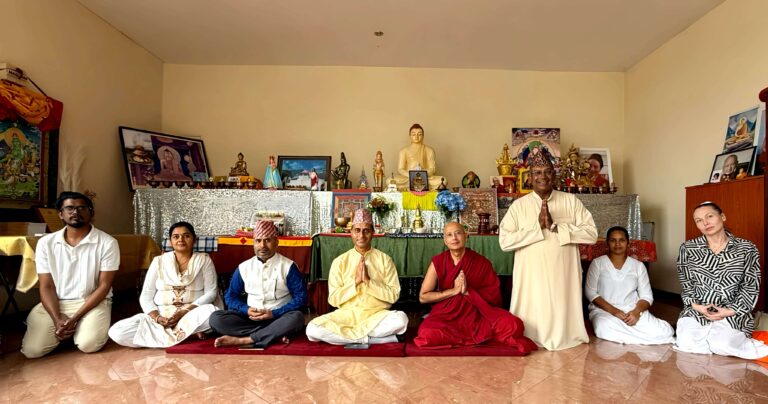
On December 21, the Northern Hemisphere reaches the winter solstice — the longest night of the year.
Throughout human history, this date has never been just another day on the calendar. For the Celts, the Norse, and the indigenous peoples of the Americas, the solstice was a threshold. It represented the moment darkness reached its absolute peak, and yet, it was the precise moment that the light began its slow, inevitable return. In the 21st century, this ancient turning point has taken on a new, global significance. December 21 is now recognized as World Meditation Day.
In 2024, the United Nations formally acknowledged this observance, moving meditation out of the realm of “lifestyle trends” and into the sphere of institutional global necessity. This recognition signals a shift in our collective understanding: we are realizing that in an age of hyper-connectivity and fragmented focus, inner regulation is not a private luxury. It is a foundational requirement for a functioning civilization.
The Deep Logic of the Solstice
The choice of the winter solstice for World Meditation Day is far from accidental. It draws upon an anthropological logic that predates modern psychology. Before we had apps for mindfulness or clinical studies on cortisol, human societies understood the power of the natural pause.
The solstice represents three distinct phases that mirror the meditative process:
1. The Acknowledgement of Limits
In agricultural societies, the shortening of daylight was an undeniable limit. It forced humans to stop expanding, stop harvesting, and stop moving. It demanded a conservation of energy. In our modern “24/7” culture, we have attempted to engineer our way out of limits. We have artificial light, constant commerce, and digital streams that never sleep. World Meditation Day is a modern return to the wisdom of the limit. It is an admission that the human nervous system cannot stay in a state of constant “harvest.” We need the dark. We need the stop.
2. The Shift Toward Interiority
When the external world becomes cold, dark, and quiet, attention naturally turns inward. Biologically, our bodies shift toward rest and repair. Psychologically, this is the movement from doing to being. Meditation is the formalization of this biological impulse. It is not a mystical flight from reality, but a grounded alignment with our own biology. By turning inward, we aren’t ignoring the world; we are checking the instrument — the mind — through which we experience that world.
3. The Subtle Transition
The solstice is not an ending, but a pivot. On December 22, the day is only seconds longer than the day before. The change is nearly invisible, yet the direction has fundamentally shifted. Meditation operates on this same principle of subtle accumulation. One session does not “fix” a life, but it shifts the orientation. It changes the trajectory from reactivity to reflection.
From Ancient Technology to Global Necessity
It is a common misconception that meditation is a “wellness activity” born from modern stress. In reality, meditation is one of humanity’s oldest technologies. Across every major continent and culture, silence and focused attention were developed as methods for training the mind.
- In Stoic Philosophy: Marcus Aurelius practiced a form of “prosoche” or constant watchfulness over his own thoughts to ensure his actions remained ethical and rational.
- In Monastic Traditions: Whether in the mountains of Tibet or the cloisters of Europe, silence was used as a tool for “contemplative discernment” — the ability to see the difference between a fleeting impulse and a deep truth.
- In Yogic Science: The mind was viewed as a “restless monkey” that required specific, repetitive training to become a useful tool for the individual.
What has changed in the modern era is not the practice itself, but the conditions of the environment that make it necessary. We are currently living through a grand experiment on the human brain.
The Modern Cognitive Crisis
We are currently facing five unprecedented pressures:
- Information Overload: We consume more data in a single day than a person in the 18th century consumed in a lifetime.
- Attention Fragmentation: Our focus is interrupted every few minutes by notifications, leading to a state of “continuous partial attention.”
- Algorithmic Reactivity: Our digital tools are designed to trigger our “lizard brain” — our fears, our outrage, and our cravings — because those are the most profitable emotions.
- The Performance Self: Social media forces us to constantly “perform” our lives rather than live them.
- The Erosion of Nuance: In a fast world, we lose the ability to sit with complexity. We want binary answers: yes or no, friend or foe, right or wrong.
Under these conditions, meditation is no longer a spiritual pursuit; it is a defensive necessity. It is “Attention Literacy.” Just as we once had to teach mass populations how to read and write to participate in democracy, we now must teach populations how to manage their own attention.
Meditation Is Not Escape
The most persistent — and dangerous — myth about meditation is that it is a form of withdrawal. People often imagine a meditator as someone who has “checked out” of the world’s problems to live in a bubble of bliss.
In its authentic form, meditation is the opposite of an escape. It is an engagement.
When you sit in silence, you aren’t leaving reality; you are finally meeting it without a filter. You encounter your own boredom, your own anger, your own prejudices, and your own physical discomfort. This is not “relaxing” in the traditional sense. It is a form of mental “weightlifting.”
Traditional teachings emphasize that the goal of calming the mind is harm reduction:
- Internal Harm: The stories we tell ourselves that create unnecessary suffering, anxiety, and self-hatred.
- External Harm: The words we say in anger, the impulsive decisions we make, and the ways we project our internal chaos onto our neighbors and colleagues.
A mind that has been trained to pause is a mind that is less likely to cause harm. From this perspective, meditation is a deeply practical, social act. It is preparation for wise action.
Why the World Needs Meditation Now: The Civic Case
World Meditation Day arrives at a moment of extreme global strain. We see polarization in our politics, volatility in our economies, and a general sense of “systemic burnout.”
We often try to solve these problems through external means — new laws, new technologies, or new leaders. But these are all symptoms of a deeper root: unexamined reactivity.
When a population lacks the capacity to pause and self-regulate, the collective system becomes unstable.
- Decisions are made based on the “hot” emotion of the moment.
- Empathy narrows because we are in a constant state of “fight or flight.“
- Tolerance for uncertainty vanishes, leading us toward extremist narratives.
Meditation trains the “civic capacities” required for a healthy society:
- Patience: The ability to wait for facts before forming a judgment.
- Discernment: The ability to tell the difference between a thought and a fact.
- Emotional Regulation: The ability to feel anger without letting it drive the car.
- Tolerance for Ambiguity: The comfort of not knowing the answer immediately.
The UN’s recognition of this day suggests that we are beginning to realize that the quality of our collective life is a direct reflection of the quality of our individual attention. If our attention is scattered and reactive, our society will be scattered and reactive.
A Global Day, Not a Mass Performance
It is vital to clarify that World Meditation Day is not a spectacle. It is not about thousands of people posting photos of themselves in “lotus position” for likes.
The beauty of this day lies in its radical simplicity. It asks for nothing but your presence. It is a “shared pause.”
In many traditions, silence is considered an ethical restraint. When we are silent, we are not consuming. We are not arguing. We are not producing. We are simply existing. By doing this on a global scale, we send a symbolic message: Humanity is capable of choosing reflection over reaction.
A Grounded Guide to the Practice (15–30 Minutes)
If you wish to mark this day, you do not need a special cushion, a mantra, or a belief system. You simply need a willingness to observe. Follow this structured approach to align with the ethical and practical foundations of the practice:
1. The Silence
Find a place where you can sit undisturbed. Keep your spine straight but not rigid. You are looking for a posture that represents “alert relaxation.” Close your eyes or soften your gaze.
The Body Scan: Spend the first five minutes moving your attention slowly from your scalp to your toes. Notice where you are holding stress — the jaw, the shoulders, the stomach. Do not judge the tension; simply meet it with awareness. As you notice it, it will often soften on its own. This is where we “store” the noise of the world.
2. The Refinement of Intention
Once your body feels grounded, ask yourself why you are sitting. Instead of a goal like “I want to feel peaceful,” try an altruistic intention.
“I am training my mind to be steady so that I can be a more patient parent.”
“I am clarifying my awareness so I can make better decisions for my community.”
This turns the practice from a self-absorbed activity into a service.
3. The Dedication
Before you open your eyes, consciously “give away” the calm you have generated. Imagine the steadiness you feel extending to your next conversation, your next email, or your next disagreement. This bridge is where meditation becomes life.
Beyond the Day: The Cumulative Effect
World Meditation Day is a symbolic spark, but the true value of meditation is found in consistency. Meditation does not remove the difficulties of the world. It does not stop the winter from being cold. What it does is change your relationship to those difficulties. Pain still happens, but the suffering caused by your resistance to that pain begins to dissolve.
Over time, this practice changes the architecture of the brain. The prefrontal cortex — the part of the brain responsible for high-level decision-making — becomes more active, while the amygdala — the “fear center” — becomes less reactive.
A Quiet Counterbalance
In a world that equates “value” with “noise,” stillness is an act of rebellion. It is a refusal to be a pawn of the attention economy. It is a decision to take back the most valuable thing you own: your awareness.
World Meditation Day does not ask us to agree on a religion or a political platform. It asks for something much more fundamental: Attention.
- Attention to the body.
- Attention to the mind.
- Attention to the consequences of our actions.
On this longest night of the year, as the light begins its slow return, let us remember that clarity is not something we go out and “find.” It is something that arises naturally when we finally stop making so much noise.
Stillness is not passive. It is preparatory. It is how we prepare ourselves to meet the world more clearly.

© 2025 Svety Oklad | Meditation Coach, Digital Creator & Wellness Tech Explorer.
Based in Dubai, working worldwide in content creation, SEO, and WordPress optimization.
Please, send your inquiry via contact form.
Discover my portfolio of mindfulness projects, brand collaborations, and digital media strategies. Follow my journey on Instagram and YouTube for meditation, travel, and creative content.